

Reviewed by Kyle Hierholzer, LMT, CPT. Updated October 2026.
These stretches are approved and recommended by Kyle Hierholzer, LMT, CPT, and they are the same ones he builds into personal training sessions with Hand in Health patients who are working through low back pain. Kyle is both a licensed massage therapist and a certified personal trainer with a corrective-exercise background, a pairing most clinics keep in separate buildings. It is what sets Hand in Health apart across Syracuse and Onondaga County, where our dual-certified providers treat back pain from both sides: hands-on soft tissue work to release what is tight, plus the corrective movement and stretches that keep it from coming back. You can do the stretches below at home.
Quick answer: Six gentle stretches can ease everyday lower back tightness at home: knee-to-chest, cat-cow, child’s pose, a supine spinal twist, cobra and a standing backbend. Move slowly, stop if you feel sharp pain, and see a provider if your pain is severe, came from an injury or won’t let up.
Move gently
Ease into each stretch and breathe. A mild pull is fine, sharp pain is not. Stop and check with a provider if a stretch increases your pain or you notice any change or loss of sensation. If your back pain is severe, came from an injury, or will not let up, see a provider before starting a routine. If you have osteopenia or osteoporosis, talk to your provider first.
Back pain is one of the most common reasons people walk through our doors, and left alone it has a way of sticking around. The research lines up with what we see every day. The American Massage Therapy Association points to solid evidence that therapeutic massage helps persistent low back pain, with benefits that last. Massage calms tight muscles, improves circulation, eases pain, and gets you moving again faster, especially when you pair it with the right strengthening and stretching. And it is not rare. The CDC reports about 1 in 4 American adults has dealt with back pain in the last three months, and most adults have back pain at some point in their lives. If your back pain is more than everyday tightness, our guide on what to do about lower back pain walks through the causes and when to seek care.
Need hands-on help? See our back pain relief options in Syracuse.
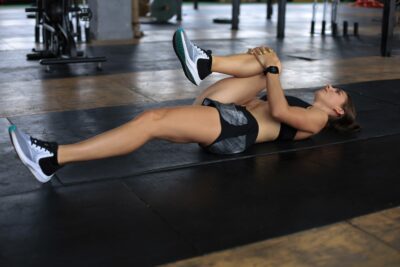
Knee-to-Chest
This is usually where I start people. It lengthens the lower back and takes pressure off the muscles that lock up after a long day.
- Lie on your back with your knees bent and your heels flat on the floor.
- Use both hands to pull one knee up toward your chest.
- Hold for about 5 seconds. Keep your stomach tight and your lower back pressed into the floor.
- Lower the leg back down and switch sides.
Do 2 to 3 rounds on each leg, twice a day.
Cat-Cow
A go-to for loosening a stiff back. It gets the whole spine moving and releases tension through the mid and lower back.
- Start on your hands and knees with your knees about hip-width apart.
- Round your back up toward the ceiling and draw your belly button up.
- Slowly reverse it, letting your belly drop and your back gently arch.
- Move with your breath, slow and easy.
Repeat 3 to 5 times, twice a day.

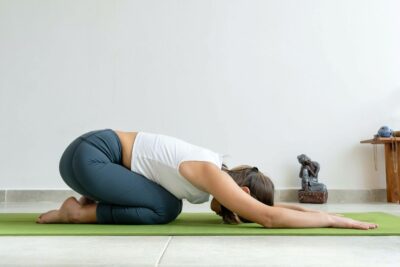
Child’s Pose
This one feels like a reset. It opens up the lower back, hips, and glutes, and quiets tension all the way up the spine.
- Start on your hands and knees.
- Sit your hips back toward your heels and reach your arms out in front of you.
- Let your forehead rest on the floor and your chest sink toward the ground.
- Breathe slowly and hold.
Hold for 20 to 30 seconds and repeat a few times when your back feels tight.
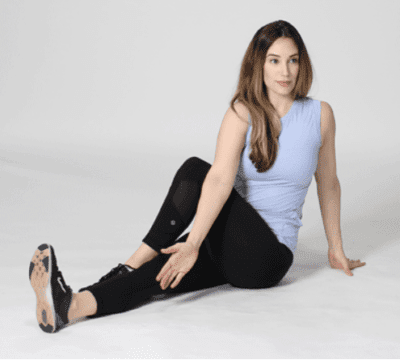
Piriformis (Supine Spinal Twist)
The piriformis sits deep in the glute and gets cranky when you sit too much. This gentle twist targets it along with the lower back.
- Lie on your back with both knees bent and feet flat.
- Let both knees drop slowly to one side while you turn your head the other way.
- Keep both shoulders on the floor and breathe into the stretch.
- Hold, then come back to center and switch sides.
Hold 20 to 30 seconds, 2 to 3 times on each side.
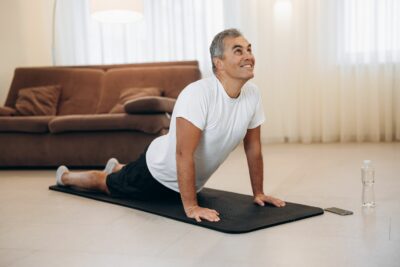
Cobra
A nice counter to all the forward bending we do all day. It gently extends the lower back and helps you stand taller.
- Lie face down with your hands under your shoulders and your palms flat.
- Set your feet about hip-width apart. Your big toes can touch.
- Gently engage your lower back, glutes, and thighs as you lift your head and chest.
- Keep your pelvis pressed into the floor, look straight ahead, and keep breathing.
Hold 30 seconds to 1 minute, 2 to 3 times.
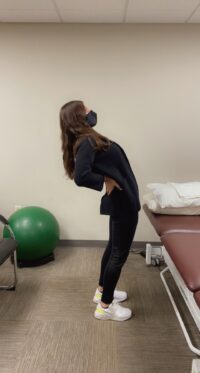
Standing Backbend
When you have been at a desk for hours, this is the one. It reverses that hunched-forward position and takes the ache out of a stiff lower back.
- Stand tall with your feet about shoulder-width apart and your hands on your hips.
- Keep your knees straight and your eyes forward.
- Lean back slowly to a comfortable point and hold for a few seconds.
- Keep your shoulders and neck relaxed, do not look up, and keep breathing.
Repeat 10 to 20 times.
Heads up: Skip this one if you have spinal stenosis or spondylolisthesis, or if leaning back sends pain or symptoms down your legs. Check with a provider if you are not sure.
If stretching is not enough, our chiropractor, Dr. Andrew Koh, DC, can find out what is behind your back pain.
A Hand in Health story: Ray
Ray came to Hand in Health with low back pain that made the simple things hard, including getting down onto the floor. Kyle started him on these stretches one on one, and Ray kept them going at home between sessions. Over a few weeks his back pain eased, and the moment that stuck with us was a small one: he got down on the ground to play with his granddaughter again. That is the whole point, movement that gives you your life back.
Back Stretching FAQs
What is the best stretch for lower back pain?
Knee-to-chest is usually where we start. It lengthens the lower back and takes pressure off the muscles that tighten up after a long day. Cat-cow and child’s pose are good next steps.
How often should I stretch for lower back pain?
Most of these stretches work best done gently twice a day. Hold or repeat each one as described above, and ease off on days your back feels sore.
Should stretching hurt?
No. A mild pull is fine, but sharp pain is not. Stop and check with a provider if a stretch increases your pain or you notice any change or loss of sensation.
When should I get help instead of stretching on my own?
See a provider if your back pain is severe, came from an injury or won’t let up after a few weeks of stretching. Get emergency care right away for back pain with loss of bladder or bowel control, numbness in the groin or inner thighs, or new leg weakness.
Still fighting back pain?
Stretching helps, but it works even better alongside hands-on care. Book with our dual-certified team in North Syracuse or Downtown Syracuse and we will treat the cause, not just the ache.
Book an appointment, call Downtown at 315-937-5953 or North Syracuse at 315-937-5954, or text us at 315-937-2300.